
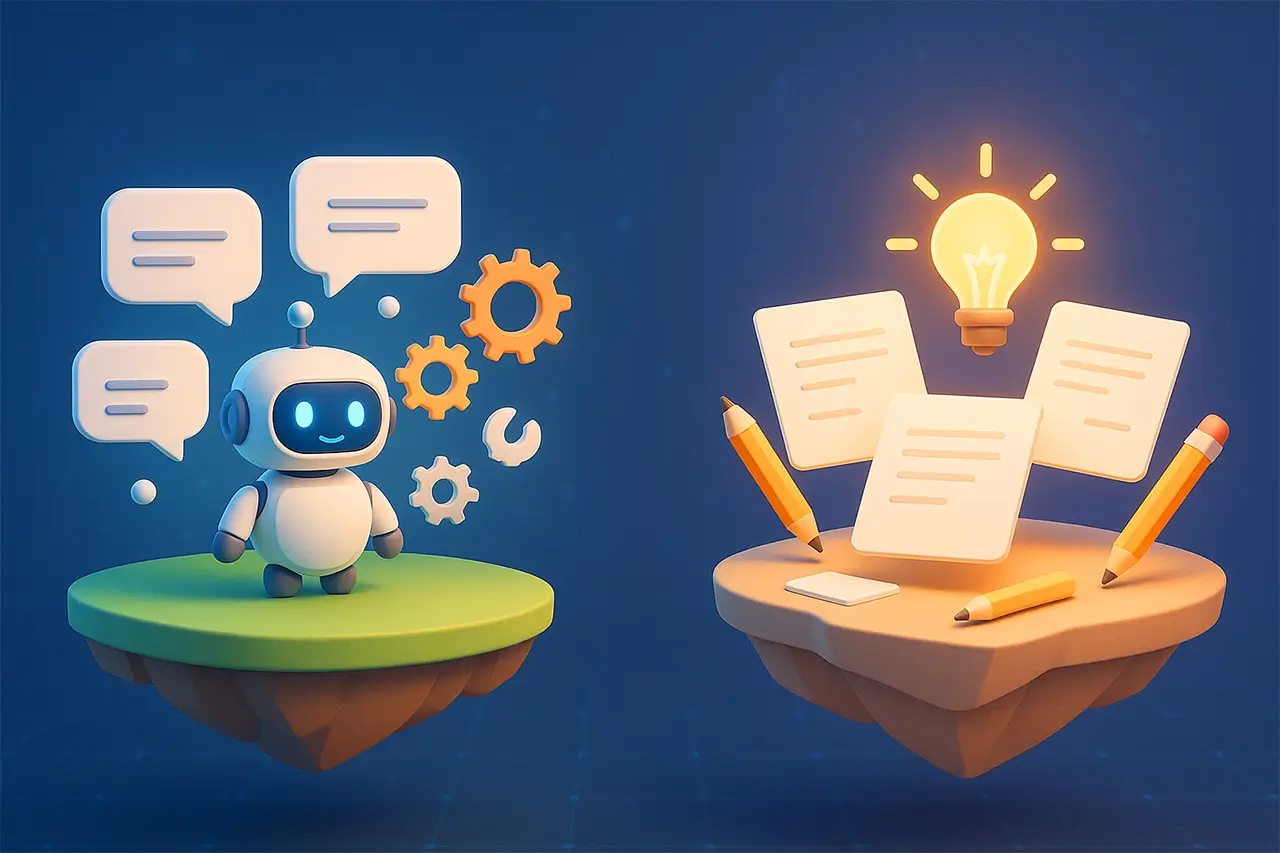
Artificial Intelligence is now an everyday tool in business. Companies use it to write content, answer customer questions, plan marketing campaigns, and much more. Two words that come up often are GPTs and prompts. Many people think they mean the same thing, but they do not. Understanding the difference will help you make smarter decisions about how to use AI in your business.
When exploring GPTs vs prompts, the key distinction is ownership and reusability. GPTs are specialized AI models you can customize and reuse repeatedly, while prompts are the specific instructions you give to any AI model. Both work together to create powerful workflows, but knowing when to invest in each approach can transform your business efficiency and output quality. Making the right choice between GPTs vs prompts depends on your specific business needs and goals.
What Are GPTs?
A GPT, short for Generative Pre-trained Transformer, is the AI model itself. It is the “engine” that powers everything, trained on massive amounts of text so it can understand language and generate human-like responses.
GPTs are custom trained agents inside ChatGPT, a tailored version of ChatGPT, the most powerful and popular AI platform on the planet. According to OpenAI’s official documentation, a custom GPT can be built for specific uses. For instance, an ecommerce store might have a GPT that specializes in writing SEO product descriptions, while a clinic might use one that explains medical information in simple terms.https://platform.openai.com/docs/guides/gpts
This makes GPTs like employees with special training. They can perform many jobs, but when you train them for a particular role, they get better and faster at delivering results that match your business needs.
What Are Prompts?
A prompt is the instruction you give to a GPT. It is the text input that tells the AI what to do. Without prompts, GPTs sit idle. Prompts can be short, such as “Write a thank-you email for new customers,” or detailed, like “Write a 500-word article about the benefits of solar energy in a professional but easy-to-read style, and end with a call to action.”
Prompts are critical because they guide the GPT. A poorly written prompt often leads to generic or confusing answers. A clear prompt leads to useful, high-quality results. In simple terms, the GPT is the car, and the prompt is the driver telling it where to go.
GPTs vs Prompts: Side-by-Side Comparison
To help you understand the difference between GPTs and prompts, here’s a direct comparison:
| Feature | GPTs | Prompts |
|---|---|---|
| Ownership | You own and can customize | One-time instructions |
| Reusability | High – use repeatedly | Medium – can save and reuse |
| Setup Time | Higher – requires training | Lower – write and use immediately |
| Cost | Investment upfront | Pay per use |
| Best For | Recurring, specialized tasks | Quick tasks and experimentation |
| Examples | Customer service bot, content writer | “Write a blog post about AI” |
When to Use Which
Choose GPTs when you:
- Have recurring tasks that need consistency
- Want to maintain brand voice across content
- Need specialized knowledge for your industry
- Have a team that will benefit from shared AI tools
Choose Prompts when you:
- Need quick, one-off results
- Want to experiment with different approaches
- Are just starting with AI and learning what works
- Have varied tasks that don’t repeat often
Build Better Workflows with Our GPT Bundles
Ready to supercharge your AI workflow? Our Top Rated GPT Bundles combine the best of both worlds – specialized GPTs for consistent results and proven prompts for flexibility. Shop now to discover professionally crafted AI tools that save time and boost quality.
How GPTs and Prompts Work Together
GPTs and prompts are not separate choices. They depend on each other. Even the most advanced GPT cannot deliver the right results if the prompt is weak. At the same time, a strong prompt can make a standard GPT perform much better.
For business owners, the GPTs vs prompts distinction creates two ways to boost results: invest in custom GPTs tailored for your industry, or build a collection of well-tested prompts that your team can use again and again. Many businesses do both, combining the strength of a specialized GPT with the flexibility of reusable prompts.
Benefits of Using GPTs in Business
Custom GPTs bring major advantages to businesses. They are consistent, efficient, and accurate. For example, a real estate agency can use a GPT trained to write property listings, while a law office can rely on one built to create professional letters and contracts.
Key benefits include:
- Saving time on repetitive writing tasks.
- Reducing costs by automating content creation.
- Keeping a consistent voice across marketing, emails, and websites.
Instead of starting from scratch every time, businesses can rely on GPTs to handle the heavy lifting while their teams focus on strategy and customer service.
Benefits of Using Strong Prompts
Prompts are powerful because they shape how the GPT responds. A single change in wording can turn a bland answer into a detailed and engaging one.
Strong prompts help businesses:
- Get high-quality results with less editing.
- Speed up workflows by reusing instructions.
- Standardize communication across teams.
Even if you do not have a custom GPT yet, learning how to write better prompts can make AI far more effective for your business.
Common Mistakes to Avoid
When working with GPTs vs prompts, businesses often make these critical mistakes:
- Expecting perfect results immediately – Both GPTs and prompts require testing and refinement to deliver optimal results
- Using vague or unclear instructions – Generic prompts like “write something good” waste time and produce poor results
- Not customizing for your brand voice – Failing to train GPTs or craft prompts that reflect your company’s tone and style
- Over-relying on AI without human oversight – Always review AI output, especially for sensitive or technical content
- Choosing the wrong tool for the task – Using expensive custom GPTs for simple one-off tasks, or relying on basic prompts for complex recurring workflows
Frequently Asked Questions
Q: What’s the difference between GPTs vs prompts in practice?
A: GPTs vs prompts work differently – GPTs are reusable AI models you customize, while prompts are one-time instructions. Well-crafted prompts work across different AI models, but you may need to adjust wording since each GPT has unique capabilities.
Q: How much does it cost to create a custom GPT vs using prompts?
A: Custom GPTs require an upfront investment in training and setup, typically ranging from hundreds to thousands of dollars. Prompts cost only the usage fees per conversation, making them ideal for testing before investing in custom solutions.
Q: Which is better for small businesses just starting with AI?
A: Start with well-crafted prompts to learn what works for your business. Once you identify recurring tasks and workflows, consider investing in custom GPTs. This approach minimizes risk while maximizing learning.
For more advanced strategies, explore our Context Window Optimization guide and GPT Best Practices tutorial.
Despite the benefits, businesses often face challenges when using GPTs and prompts. One issue is over-reliance. Some expect AI to replace human creativity, but AI works best as a partner, not a replacement.
Another common issue is unclear prompts. If you simply type “write something about marketing,” the answer will likely be too broad. GPTs need specific instructions to deliver useful content.
For GPTs, the challenge is customization. Setting up a GPT that truly matches your industry requires the right data and a clear plan.
Safety and Reliability
Safety is another important factor. GPTs inside ChatGPT are designed to be secure, but businesses should still avoid putting private data directly into prompts. Sensitive information like customer records should not be shared with AI tools.
Reliability is also key. GPTs sometimes generate text that looks correct but is factually wrong. This is why human review is necessary, especially for industries like healthcare, finance, or legal services. Over time, with better prompts and fine-tuned GPTs, accuracy improves.
The Results Businesses Can Expect
When GPTs and prompts are used together the right way, businesses see clear results. They can produce content faster, launch marketing campaigns sooner, and communicate with customers more effectively.
The impact shows up in customer satisfaction too. Clients receive professional emails, helpful content, and clear answers without delays. Businesses benefit from stronger branding, better SEO, and more time to focus on growth.
Final Thoughts
The GPTs vs prompts relationship is simple but powerful. GPTs are the trained agents inside ChatGPT, while prompts are the instructions that guide them. One cannot work without the other.
If you are just starting, focus on writing clear and specific prompts. As your business grows, consider investing in custom GPTs designed for your industry. Together, they can save time, cut costs, and deliver results that strengthen your business.
AI is not here to replace your business. It is here to help you run it more smoothly and effectively. And everything begins with understanding how GPTs and prompts work together. The choice between GPTs vs prompts ultimately determines your AI strategy’s success.
Deeper Dive: GPT Customization vs Prompting Strategies
Understanding GPTs vs prompts differences becomes clearer when you examine their strategic approaches. GPT customization involves training models with specific datasets, behavior patterns, and knowledge bases tailored to your industry. This creates persistent intelligence that remembers context and maintains consistency across interactions.
Prompting strategies, conversely, rely on crafting precise instructions that guide any AI model toward desired outcomes. Advanced prompting techniques include chain-of-thought reasoning, few-shot examples, and structured templates that can be applied across different AI platforms.
5 Practical Business Use Cases for GPTs vs Prompts
Use Case 1: Customer Service Automation
GPT Approach: Train a customer service GPT with your product documentation, FAQs, and brand voice guidelines. This specialized agent handles inquiries consistently while maintaining your company’s tone.
Prompt Approach: Create detailed prompt templates for common customer scenarios: “Act as a helpful customer service representative for [Company]. Address this customer inquiry professionally: [Customer Question]. Provide accurate information based on these guidelines: [Company Policies].”
Use Case 2: Content Marketing at Scale
GPT Approach: Develop a content marketing GPT that understands your industry, target audience, and content style. It generates blog posts, social media content, and email campaigns that align with your brand strategy.
Prompt Approach: Use systematic prompts like: “Create a 500-word blog post about [Topic] for [Target Audience]. Use a professional yet approachable tone, include actionable tips, and end with a clear call-to-action.”
Use Case 3: Sales Proposal Generation
GPT Approach: Train a sales GPT with your service offerings, pricing models, and successful proposal examples. It generates customized proposals that match your sales methodology.
Prompt Approach: Structure prompts with: “Generate a sales proposal for [Client Name] in [Industry]. Include these services: [Service List]. Address their specific challenges: [Client Pain Points]. Use this pricing structure: [Pricing Framework].”
Use Case 4: Technical Documentation
GPT Approach: Create a technical writing GPT that understands your products, follows your documentation standards, and maintains technical accuracy across all materials.
Prompt Approach: Use prompts such as: “Write technical documentation for [Feature]. Explain it for [Skill Level] users. Include step-by-step instructions, common troubleshooting tips, and relevant screenshots.”
Use Case 5: Market Research Analysis
GPT Approach: Develop a research GPT trained on your industry data, competitor information, and analytical frameworks to generate consistent market insights.
Prompt Approach: Create research prompts: “Analyze this market data: [Data]. Identify key trends, competitive opportunities, and potential risks. Present findings in a structured report format with actionable recommendations.”
Step-by-Step Framework: Choosing GPTs vs Prompts
Step 1: Evaluate Task Frequency
- High frequency (daily/weekly): Consider custom GPT
- Low frequency (monthly/occasional): Use prompt-based approach
Step 2: Assess Consistency Requirements
- Strict brand voice needed: GPT customization preferred
- Flexible output acceptable: Prompts work well
Step 3: Calculate Investment vs Return
- GPT Investment: Training time + setup costs + maintenance
- Prompt Investment: Template creation + testing + refinement
Step 4: Consider Team Collaboration
- Multiple users: GPT provides standardized results
- Individual use: Prompts offer more flexibility
Step 5: Plan for Scalability
- Growing needs: GPT adapts through retraining
- Static requirements: Prompts remain consistent
Common Pitfalls and How to Fix Them
Pitfall 1: Over-Engineering Simple Tasks
Problem: Using expensive custom GPTs for basic, infrequent tasks.
Solution: Start with well-crafted prompts. Upgrade to GPTs only when volume and consistency justify the investment.
Pitfall 2: Underestimating Prompt Quality
Problem: Creating vague, generic prompts that produce inconsistent results.
Solution: Invest time in prompt engineering. Include context, specify format, provide examples, and test extensively.
Pitfall 3: Ignoring Maintenance Requirements
Problem: Assuming GPTs or prompts work perfectly without ongoing optimization.
Solution: Schedule regular reviews, gather user feedback, and continuously refine both GPTs and prompt libraries.
Pitfall 4: Poor Integration Planning
Problem: Implementing AI solutions without considering existing workflows.
Solution: Map out current processes, identify integration points, and ensure smooth adoption across your team.
Advanced Tips for Maximum ROI
Prompt Templates for Consistency
Develop standardized templates that team members can customize:
Email Template: “Compose a [Type] email for [Audience]. Topic: [Subject]. Tone: [Professional/Casual]. Include: [Key Points]. Call-to-action: [Specific Action].”
Content Template: “Create [Content Type] about [Topic] for [Audience]. Length: [Word Count]. Include: [Required Elements]. Optimize for: [Keywords/Goals].”
Evaluation Frameworks
Implement systematic evaluation methods:
- Quality Scoring: Rate outputs on accuracy, relevance, and brand alignment (1-10 scale)
- Efficiency Metrics: Track time saved, error reduction, and productivity gains
- User Satisfaction: Gather feedback from team members using the AI tools
AI Governance Best Practices
- Access Controls: Define who can create and modify GPTs or prompt libraries
- Quality Standards: Establish minimum requirements for AI-generated content
- Review Processes: Implement approval workflows for customer-facing content
- Data Privacy: Ensure sensitive information never enters AI prompts or training data
Mini Case Study: Marketing Agency Success
Digital Marketing Pro, a 15-person agency, struggled with inconsistent content quality across client accounts. They implemented a hybrid GPTs vs prompts approach:
Challenge: Different team members produced varying content styles, making brand management difficult for clients.
Solution:
- Created industry-specific GPTs for their top 5 client sectors (healthcare, finance, e-commerce, real estate, technology)
- Developed standardized prompt libraries for common deliverables (blog posts, social media, email campaigns)
- Trained team members on both approaches
Results:
- Content production time decreased by 40%
- Client satisfaction scores increased by 25%
- Team consistency improved dramatically
- New client onboarding became 60% faster
Key Insight: The combination approach allowed specialists to use GPTs for their expertise areas while maintaining prompt flexibility for diverse client needs.
Conclusion: Maximizing Your AI Strategy Success
The GPTs vs prompts explained journey reveals that success lies not in choosing one over the other, but in understanding when each approach delivers maximum value. GPTs vs prompts differences create complementary strengths that, when combined strategically, transform business efficiency.
Key differences between GPTs and prompts ultimately serve different business needs. Custom GPTs excel at consistent, high-volume tasks requiring specialized knowledge, while well-crafted prompts provide flexibility and immediate results for varied requirements.
Start your AI transformation today: audit your current processes, identify repetitive tasks that need consistency (GPT candidates), and create a prompt library for flexible needs. As your experience grows, you’ll naturally develop an intuitive sense for the right tool for each situation.
Ready to implement these GPTs vs prompts strategies? Explore our comprehensive AI workflow templates and training resources to accelerate your success. Contact our team for personalized guidance on building your optimal AI strategy.






0 Comments